




Regulated Broker


 Author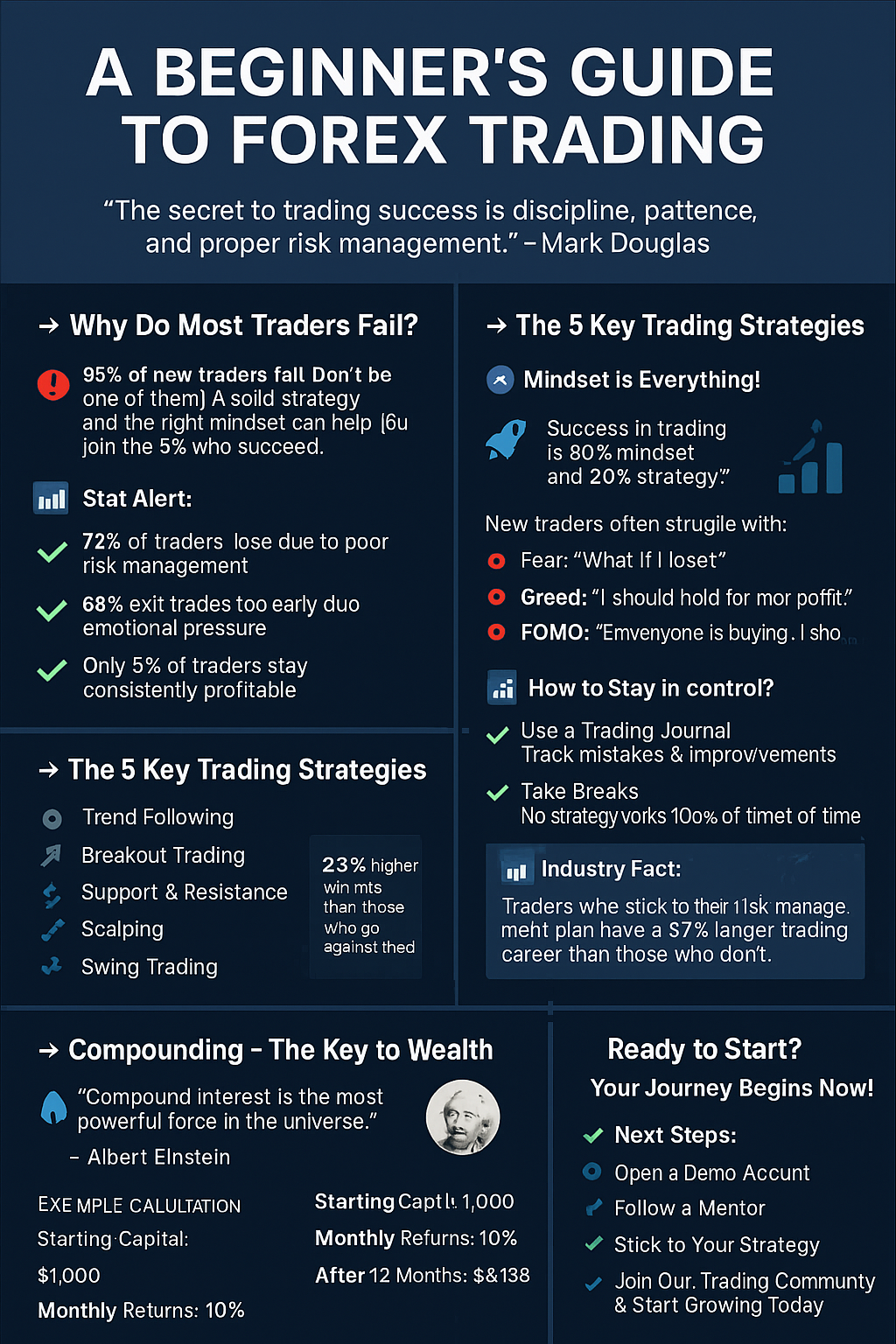
Trading success requires discipline, patience, continuous learning and proper risk management. Forex trading offers opportunities, but it also involves significant risk. New traders should focus first on building knowledge and developing a structured approach rather than chasing quick profits.
Many new traders enter the market without a clear trading plan. Poor risk management, emotional decision-making, overtrading and unrealistic expectations can quickly lead to losses.
A more disciplined approach starts with three basic principles.
Follow a Trading Plan
Define your entry, exit and risk conditions before entering a trade. Avoid changing your plan simply because the market moves against you.
Manage Risk
Decide how much of your trading capital you are prepared to risk on each trade. Position size should be based on your account size, strategy and risk tolerance.
Control Emotions
Fear, greed and frustration can affect decision-making. A predefined trading process can help reduce emotional decisions.
Trend-following traders attempt to identify the overall direction of the market and look for opportunities in the same direction.
Breakout traders look for price movements beyond important support, resistance or consolidation areas. The objective is to participate when price begins moving outside its previous range.
Support and resistance traders identify important price areas where buying or selling activity has previously appeared. These levels can help traders plan potential entries, exits and risk levels.
Scalping involves taking multiple short-duration trades and attempting to capture relatively small price movements. Because trades happen quickly, execution and risk management are particularly important.
Swing traders generally hold positions for several days or sometimes weeks. The objective is to capture a larger portion of a market movement rather than very short-term fluctuations.
Trading is not only about finding entries and exits. Psychology can have a major influence on how consistently a trader follows a strategy.
New traders commonly experience the following emotions.
Fear
A trader may close a position too early because of fear of losing money.
Greed
A trader may continue holding a profitable position beyond the original trading plan in the hope of making more.
Fear of Missing Out
A trader may enter a market simply because prices are moving quickly or because other traders appear to be making money.
Maintain a Trading Journal
Record your trades, reasons for entering, risk levels, results and mistakes. Over time, this can help identify patterns in your trading behaviour.
Take Breaks
More trading does not necessarily mean better results. Taking a break can be useful when frustration or emotion begins influencing decisions.
Follow the Process
No trading strategy works all the time. A strategy should be evaluated across a meaningful number of trades rather than judged from one winning or losing position.
Compounding means reinvesting returns so that future gains are calculated on a larger amount of capital.
For example, mathematically, if 1,000 dollars increased by 10 percent every month and all gains were reinvested, the amount would grow to approximately 3,138 dollars after 12 months.
This is a mathematical illustration rather than an expected trading return. Achieving a consistent 10 percent monthly trading return is not guaranteed, and actual trading can result in losses.
The important lesson is to think long term. Consistency, capital preservation and risk management are generally more important than trying to generate unusually large short-term returns.
Taking more trades does not automatically produce more profit. Traders should focus on opportunities that meet their strategy rather than trading simply because the market is open.
A good trading idea can still result in a significant loss if position size and downside risk are not properly controlled.
Trading requires patience. There will be periods when suitable opportunities are limited. Waiting for conditions that match your trading plan can be just as important as entering a trade.
Beginners can start by learning how markets work and practising in a demo environment before considering live trading.
Open a Demo Account
Use a demo account to become familiar with the trading platform, order execution and risk management without risking real capital.
Continue Learning
Learn from experienced educators, study different market conditions and understand the risks associated with leveraged trading.
Follow Your Strategy
Develop clear trading rules and evaluate your results over time. Avoid constantly changing strategies based on individual winning or losing trades.
Successful trading is not about finding a strategy that never loses. It is about developing a structured process, controlling risk, managing emotions and continuing to learn from both successful and unsuccessful trades.
Learn first. Manage risk. Trade with discipline.
Risk Warning: Forex and leveraged products involve a high level of risk and may not be suitable for all investors. Past performance does not guarantee future results.
 Read More